Description
Diacalymene Trilobite Fossil Nodule
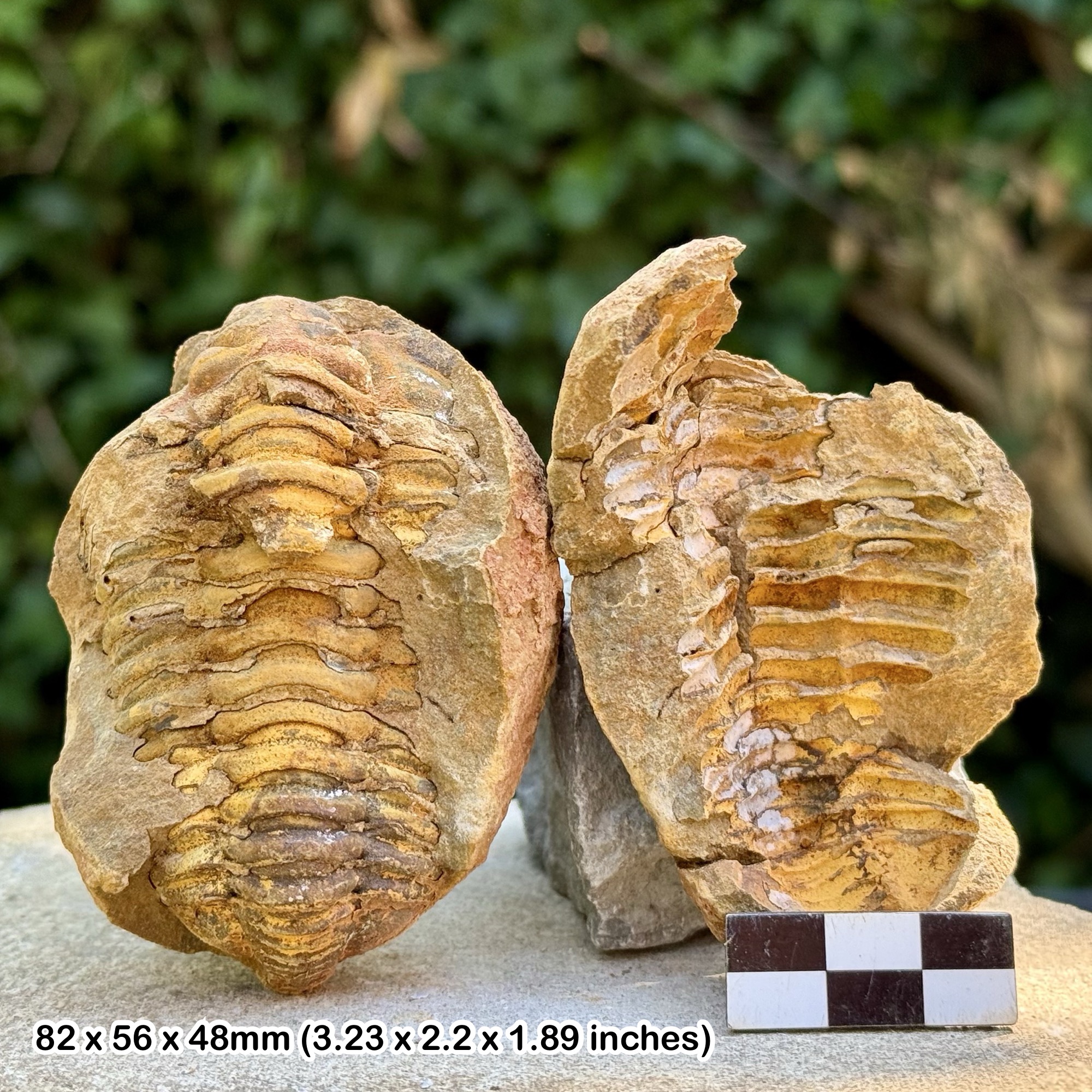
This fossil specimen features a Diacalymene trilobite preserved as a nodule with both positive and negative halves. The paired halves are especially appealing to fossil collectors because they present the complementary surfaces created when the nodule separated, allowing the fossil-bearing form and its corresponding impression to be viewed together. This format provides an informative display of how a fossil can be preserved within surrounding rock.
Geological Identification
The specimen is identified as Diacalymene and is associated with the Ktaoua Group of the Upper Ordovician. The locality is the Anti-Atlas Region of Morocco, a well-known area for Paleozoic fossil material. The Upper Ordovician was a significant period in marine life history, when trilobites formed part of diverse ocean ecosystems alongside brachiopods, cephalopods, bryozoans and other marine organisms.
Diacalymene belongs to the trilobites, an extinct group of marine arthropods. Trilobites are recognised by their three-lobed body plan, consisting of a central axial region and two lateral pleural regions, as well as their segmented exoskeleton. Their remains are valued by collectors for the combination of scientific interest, distinctive morphology and the wide range of geological settings in which they occur. The identification supplied for this specimen is presented at the Diacalymene level.
Positive and Negative Fossil Halves
A positive and negative pairing is useful for display and study because the two parts show opposing relief. The positive half carries the raised fossil form, while the negative half preserves the corresponding impression in the adjoining material. Together, these pieces can help viewers appreciate the three-dimensional nature of the fossil and the relationship between the fossil and its surrounding nodule.
The nodule presentation also gives the specimen a natural geological appearance rather than showing only an isolated fossil removed from its enclosing rock. It is suitable for a private fossil collection, educational display, geology cabinet or natural history presentation. The contrasting surfaces can be arranged together or displayed separately according to preference.
Locality and Geological Interest
The Anti-Atlas Region of Morocco is internationally recognised for its rich geological record and varied fossil material. Material associated with the Ktaoua Group and the Upper Ordovician is of interest to collectors studying the marine fossil history of North Africa and the development of Paleozoic life. This specimen combines a named trilobite identification with a clearly stated geological group and period, making it a useful addition to a collection focused on trilobites, Ordovician fossils or Moroccan geology.
Photograph and Certificate
The photograph shows the actual specimen you will receive.
This Fossil is a genuine specimen and Includes a Certificate of Authenticity lifetime guarantee generic card.
Full sizing is shown in the photographs. Please examine the images carefully to appreciate the preserved positive and negative halves, the natural nodule presentation and the overall appearance of this individual fossil specimen.