Description
Specimen Identification
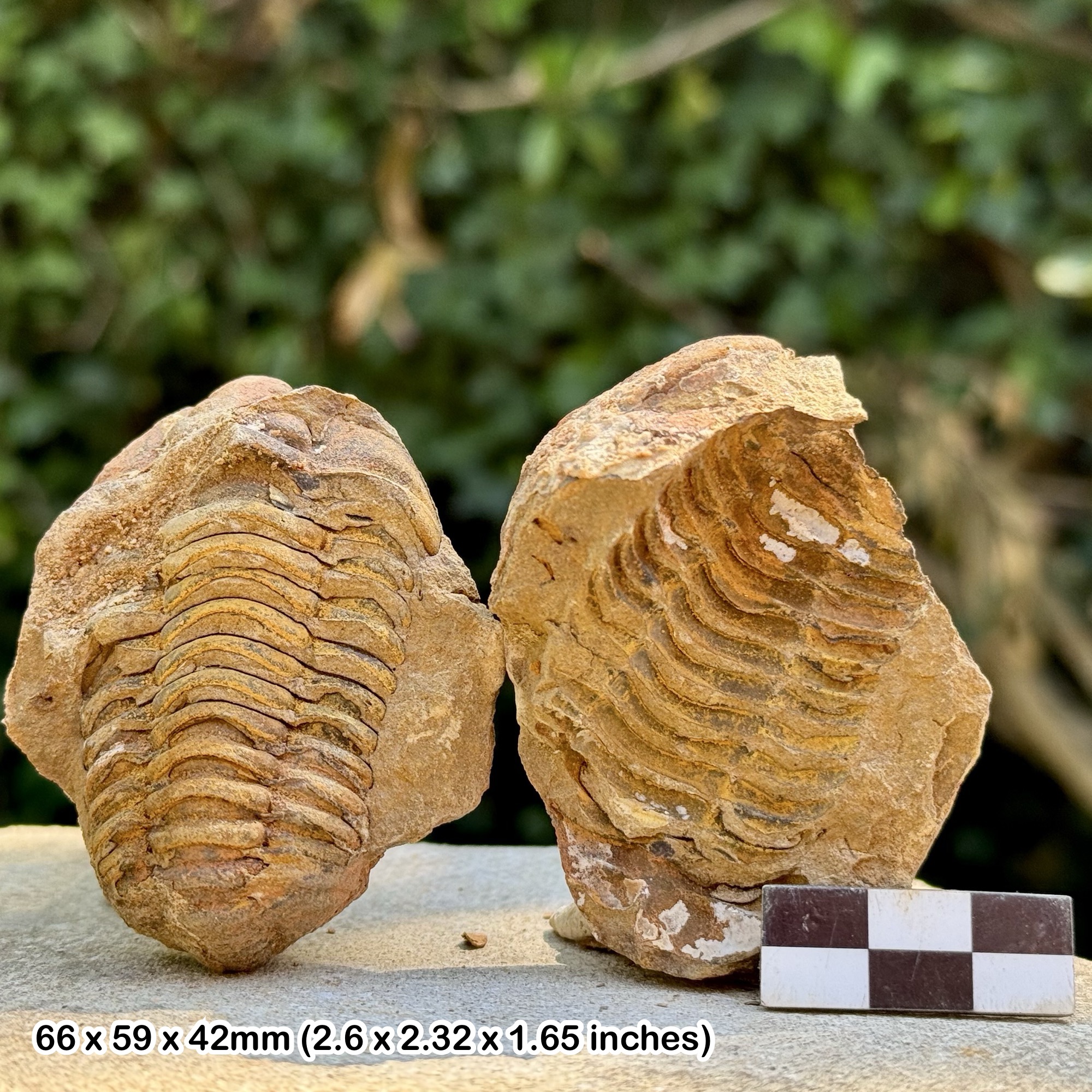
This listing features a Diacalymene trilobite fossil preserved in a nodule with both positive and negative halves. The paired presentation shows the fossil-bearing split surface and provides an appealing format for collectors who appreciate the relationship between the exposed fossil and the corresponding counterpart. The specimen is identified as Diacalymene and is described as an Upper Ordovician trilobite from the Ktaoua Group.
Geological Setting
The fossil comes from the Anti-Atlas Region of Morocco, an important area for Paleozoic fossil collecting and geological study. Its stated geological association is the Ktaoua Group, with an Upper Ordovician age. The Ordovician Period is a major division of the Paleozoic Era, known for significant diversification in marine life. Trilobites were among the characteristic marine arthropods of this era and are widely collected for their distinctive body forms, segmented anatomy and value in understanding ancient marine ecosystems.
Diacalymene Trilobite
Diacalymene is a trilobite identification, placing this fossil within an extinct group of marine arthropods. Trilobites had a hard, mineralised exoskeleton divided into a cephalon, thorax and pygidium, with repeated body segments that commonly remain visually recognisable in fossil material. Their fossils are valued for both their scientific importance and their strong visual appeal, particularly when the outline and segmentation are visible across a split nodule.
The positive and negative halves make this specimen especially suitable for display, study and educational use. Rather than presenting only a single exposed surface, the nodule format retains the paired counterpart arrangement associated with the original split. This gives collectors an opportunity to examine the fossil in context and display the two halves together as a complementary set.
Collector and Display Use
This Moroccan Upper Ordovician Diacalymene fossil is well suited to fossil collections, geology displays, natural-history interiors and educational settings. It offers several points of interest in one piece: a named trilobite identification, an Upper Ordovician geological association, a Ktaoua Group connection, and a locality in the Anti-Atlas Region of Morocco. The positive-and-negative-half format also makes it an engaging conversation piece for collectors interested in the preservation and presentation of fossil material.
The specimen can be displayed with both halves together or arranged so that the fossil-bearing surfaces can be viewed separately. Full sizing is shown in the photographs.
Authenticity and Photograph Information
This Fossil is a genuine specimen and Includes a Certificate of Authenticity lifetime guarantee generic card.
The photograph shows the actual specimen you will receive.