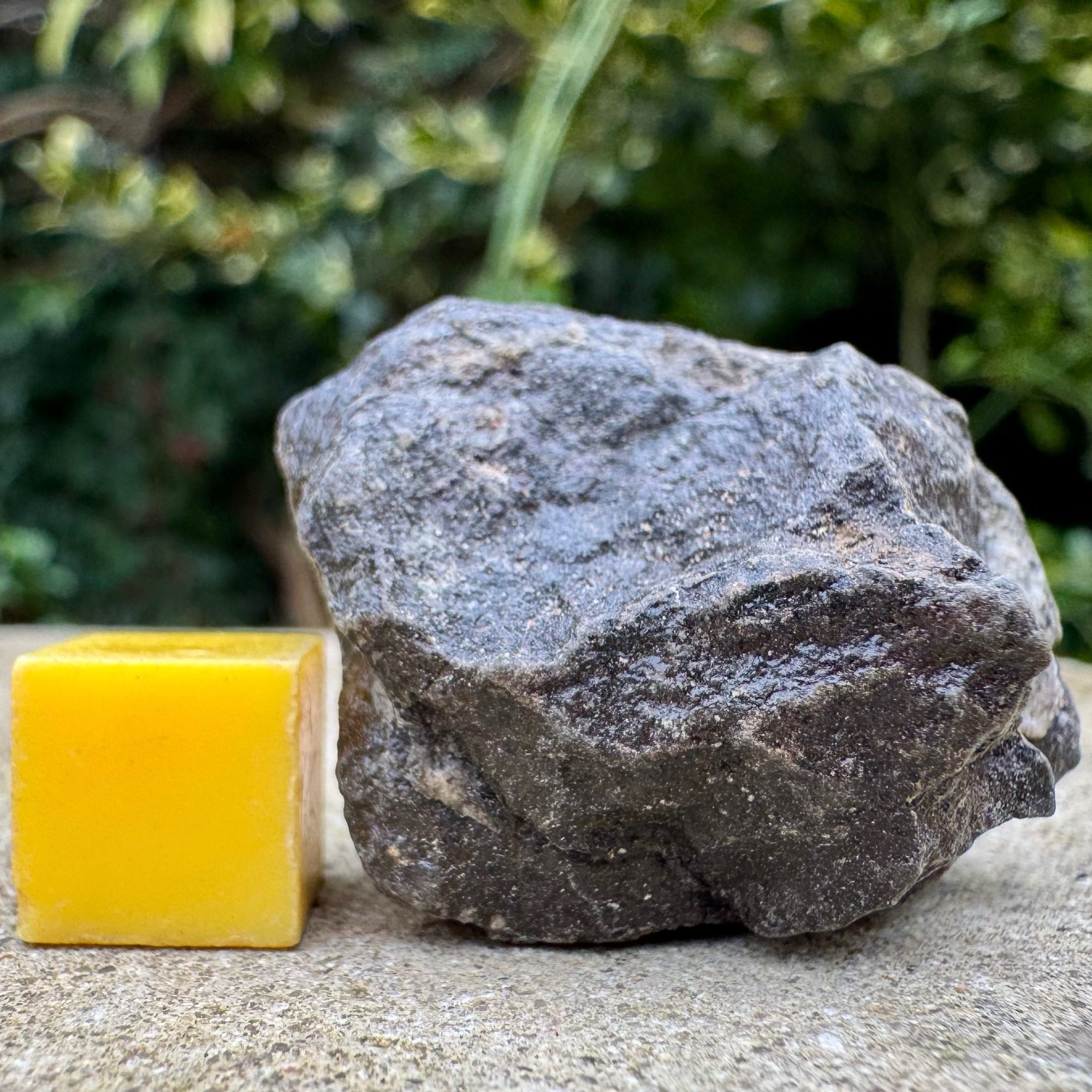
H5 Common Chondrite High Iron Meteorite – Space Rock (Medium)

SIZE (Picture scale cube=1cm): 15-35mm (Average)


These Meteorites have been found by a Berber Nomad in North Africa, and are in their original ‘as found’ condition.

H5 type meteorites are part of the H chondrite group, a subtype of ordinary chondrites, renowned for their high iron content, which gives them a distinct metallic nature. These meteorites originated from the asteroid belt between Mars and Jupiter, and they are fragments of an ancient celestial body that underwent partial melting and thermal metamorphism. The “H” in their classification denotes “high iron,” while the number “5” indicates their thermal metamorphic grade, showing that they have undergone a moderate level of heat processing on their parent body, leading to well-crystallized olivine and pyroxene minerals.


The NWA (Northwest Africa) designation reflects that these specimens were found in the Sahara Desert, where their preservation is typically remarkable due to the arid climate. H5 chondrites are particularly fascinating for collectors and researchers, as they reveal much about the early Solar System’s formation and evolution. These meteorites feature a dark matrix speckled with metal flakes, chondrules, and silicate grains, creating a visually striking contrast that showcases their extraterrestrial origin. Each H5 chondrite meteorite is a timeless piece of cosmic history, perfect for anyone interested in holding a fragment of our Solar System’s ancient building blocks.


Ultimately, the testing laboratory (The Natural History Museum in the UK) will assign a name and publish a description. The name generally refers to the region or nearest town to the location of the fall or find.


The majority of stone meteorites fall into the category of ‘Common Chondrite’. These are ancient stony objects that formed within the solar disc about 4.5 billion years ago and which are by far the most frequently discovered ‘space rocks’. Many of these are found in large ‘strewnfields’ in the North Western Sahara. While waiting for a full examination/description, these are referred to as unclassified NWA Meteorites (North West Africa Meteorites).


WILL DIFFER TO PHOTOThe image shows an example of the single specimen you will receive. This will be picked from our stock box graded and with a size approximately within the size range indicated. It will not be the same specimen shown in the photo, the colours, shape, size and style may vary as with any natural item. To guarantee the specimen you receive will be representative by that in photo, we would always recommend the Actual as seen version of this item.


Unique : (Similar to seen).

Login to see prices
SKU: MT0017 Category: Tags: ,

Download Image

Description

SIZE (Picture scale cube=1cm): 15-35mm (Average)


These Meteorites have been found by a Berber Nomad in North Africa, and are in their original ‘as found’ condition.

H5 type meteorites are part of the H chondrite group, a subtype of ordinary chondrites, renowned for their high iron content, which gives them a distinct metallic nature. These meteorites originated from the asteroid belt between Mars and Jupiter, and they are fragments of an ancient celestial body that underwent partial melting and thermal metamorphism. The “H” in their classification denotes “high iron,” while the number “5” indicates their thermal metamorphic grade, showing that they have undergone a moderate level of heat processing on their parent body, leading to well-crystallized olivine and pyroxene minerals.


The NWA (Northwest Africa) designation reflects that these specimens were found in the Sahara Desert, where their preservation is typically remarkable due to the arid climate. H5 chondrites are particularly fascinating for collectors and researchers, as they reveal much about the early Solar System’s formation and evolution. These meteorites feature a dark matrix speckled with metal flakes, chondrules, and silicate grains, creating a visually striking contrast that showcases their extraterrestrial origin. Each H5 chondrite meteorite is a timeless piece of cosmic history, perfect for anyone interested in holding a fragment of our Solar System’s ancient building blocks.


Ultimately, the testing laboratory (The Natural History Museum in the UK) will assign a name and publish a description. The name generally refers to the region or nearest town to the location of the fall or find.


The majority of stone meteorites fall into the category of ‘Common Chondrite’. These are ancient stony objects that formed within the solar disc about 4.5 billion years ago and which are by far the most frequently discovered ‘space rocks’. Many of these are found in large ‘strewnfields’ in the North Western Sahara. While waiting for a full examination/description, these are referred to as unclassified NWA Meteorites (North West Africa Meteorites).


WILL DIFFER TO PHOTOThe image shows an example of the single specimen you will receive. This will be picked from our stock box graded and with a size approximately within the size range indicated. It will not be the same specimen shown in the photo, the colours, shape, size and style may vary as with any natural item. To guarantee the specimen you receive will be representative by that in photo, we would always recommend the Actual as seen version of this item.


Unique : (Similar to seen).